


Life on the Floating Village
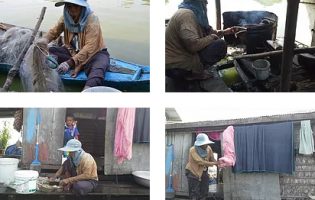
Ms. Sour, a 45 year old widow lives in Kampong Prak floating village in Tonle Sap Lake, gets up at dawn and goes to collect her large fishing nets, which she has casted the previous evening. It takes three hours for her to row her boat out to the catchment area, gather and bring in the fishing nets and return home. Still in her wet clothes, Sour gets fish out from the nets and quickly starts to prepare lunch for her family. When the food is boiling on the stove, she quickly washes her clothes to put out to dry while it is hot and sunny. Fish is her daily food. Sometimes, she buys some vegetables to add with fish to change the taste.

Sour, exhausted after the day’s work, said, “I seldom have free time. Only during dry season when the lake is too shallow that I can have a nap of an hour at noon. There are less fishes for processing so I have some time at noon.”
However, less fishes also mean less income from fishing and fish processing. To make ends meet, she often goes to cut wood far past the river-banks. She carries the heavy load of wood to back to her home floating on the lake. She dries them to sell to her neighbours as firewood.
Sour’s cousin, Sareth, 28, also lives in Kampong Prak floating village with her family. She learned fishing and fish processing from her mother, like the generations before her. She married a fellow fisherman from the same village. After her marriage, she only goes with her husband to collect the first round of fishing nets during peak season. They go early before daybreak. After they bring home the nets, Samnang leaves again with another set of nets to another fishing spot while Sareth and other family members separate the fish from fishing nets. She beheads fish and her brother-in-law removes the scales from the fish. Scaling is considered laborious work which needs more energy so it is a man’s work. Sareth does all other processing activities such as applying salt, drying, fermented and smoking. She also cooks, cleans and washes for all the family members.

During dry season, Samnang only goes out to collect fish once a day. While Sareth and the family members process the fish, he sews the nets to harvest shrimps after fishing. Shrimp harvesting is considered as an alternative source of income during dry season. This is gender division of work with men and women complementing and supplementing various tasks in fishing and fish processing. They worked hard together to sustain their life in floating village.

What does work life balance mean to Sour, Sareth and her husband ? How will they find some balance in their life?
Efforts to Find Work Life Balance
The Prahok fish paste is stored in plastic containers ready to be sold. Middlemen come to the village going from house to house to sourcing for large quantities. Sour stores her products till a middleman comes along. In the heat the quality deteriorates and thus, fetch low price. Only if she has 30 to 40 kilograms of Prahok, is it worth her while to go a few hours to Kampong Loung, the port market. If she sells to a middleman in the floating village, she earns 3,000 riel per kilogram. If she goes to sell at Kampong Loung, she earns 3,500 riel per kilogram. If the quality is not good, she may not even find a buyer. With low catch and no refrigeration, Sour and other fisher folks have little choice but to sell to the middlemen at his price.

 Some non-government organizations noticed these challenges faced by fisher folks in the floating villages on the Tonle Sap. Thousands of villagers are affected by the exploitative middlemen. One of the organizations that come to help is HARVEST which assists fisher folks and farmers to learn improved methods of food processing and marketing.
In 2012, Sareth joined the HARVEST’s project. She received training in new methods of fish processing and marketing skills. HARVEST was also concerned about the sanitation and hygiene of the fish processors which may cause water borne diseases and result in food poisoning. It provided training on sanitation and personal hygiene to reduce any health hazards to the processing activities. Sareth came to understand that by properly removing the entrails and cleaning the fishes well, the quality will be higher as less decomposition takes place. Even though it takes more time than before it is worth the efforts. She chooses a higher quality white salt in order to make the Prahok look white and clean. With her continued efforts and resilience in learning new things, she is now the leader of the members of HARVEST’s project in her floating village. The project also now includes a small community bank. She is able to save some money in the saving group and become less dependent on money lenders who charges exorbitant interests of ten to twenty percent per month.
HARVEST also helps Sareth and other members to market their product directly to wholesalers in Krakor district market which is three to four hours away. Assured of the quality of the product, these wholesalers are willing to buy directly from Sareth’s group at a higher price. Thus, they are able to cut off the middlemen. Before taking the group’s combined products to Krakor, Sareth phones the wholesalers to know the price. In this way, they can earn 500 to 1,500 riels more per kilogram of Prahok. Samnang often transport the group’s products to Krakor.
Another organization helps the fisher folks to smoke the bigger fishes and only the smaller ones are made into Prahok. In this way, they are able to diversify their products and increase their earnings.
To make his time and efforts worthwhile, Samnang also learns to start a trading business. He buys what the villagers need and sell to them at a reasonable profit. In this way, mutual support and collaboration help the inhabitants of Kampong Prak live more comfortable lives. They earn more and have more time and resources for other aspects of their lives. Their health has improved and their environment is also conserved as they do not need to cut so much of the trees to sell as firewood.
Other Collective Efforts Needed
The seasonal nature of the fishing work presents other challenges. The Tonle Sap triples its size during the rainy season. For five to six months, the fishes spawn and breed and are plentiful all around the lake. During this peak season the price of the fishes and fish products decline. Due to lack of storage facilities and refrigeration in floating villages, fisher folks and fish processors cannot store large quantities of the fishes and fish products. They are forced to sell to middlemen or wholesales at cheap price. Middlemen or wholesalers have storage facilities to store excess fishes and processed fish products to sell during off-season at higher prices. Sareth group is now trying to find funders to provide each of these floating villages, electricity and cold storage facility. The women are in the process of organizing themselves into co-operatives to source for loans and set up these facilities.
The women are also searching for organizations that will help them manage their marketing better. They want to learn how to grade their products to give an appropriate price for each of these grades of quality. They realize that as they sell their products jointly, the wholesalers still take advantage of them by paying prices based on the lowest qualities. To be fair to every member of the co-operative, they have to learn how to grade and price their products.
Associated with quality assurance is branding and packaging of their products. They have very little idea about these concepts. However, they have seen how others with better branding and packaging are able to fetch higher prices. They also need to learn about bargaining and negotiating with buyers.
Capacity building on collective work management is another component they have considered. Petty jealousy and constant arguing about prices is testing the group to sustain their nascent efforts. The community will certainly have better work life balance if they can stay united and in harmony to sustain their fragile environment and living.
Cambodian Organization for Research, Development and Education (CORDE)
Recipient of the Ten Accomplished Youth Organizations (TAYO) ASEAN Award, 2011
corde@corde.org.kh
By: San Sophany