

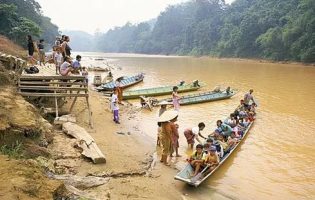

Located in the heart of Sarawak, Kampung Sungai Dua is merely one of the numerous villages that dot the banks of the Baram River. This quaint village is home to the Kayan and Kenyah people, and there are more than a thousand people officially registered in the village. However, less than 10% of them stay in the village itself, and out of that 10%, only a handful are young people.
Rural flight, meaning the migration of people from rural areas to urban areas, is not an uncommon sight in the area. In fact, most of the villages along the river are inhabited by elderly folk while the youths and adults live in towns or cities. In fact, 70% of Malaysians live in urban and semi-urban areas, and the rural areas are quickly diminishing.
Reasons behind rural flight


Image credits: www.robertharding.com
There are several reasons for this occurrence, and for most of the villagers, it starts with education. In such a small village, there are no schools. For the children to have access to education, they need to take a boat to another village or town. For example, there is no school in Kampung Long Sungai Dua, hence the children have to travel to other villages or towns that have schools such as Long Laput or Long Lama, about 45 minutes and an hour’s boat-ride respectively. As the boat fuel is not cheap, many of these children end up living in hostels or with relatives in that village or town. As the children grow older, their education needs can no longer be fulfilled by small villages or towns. They then move to bigger towns or cities in order to further their studies. These children spend their childhood away from their homes, so it is not surprising that they would rather set down roots in big cities rather than their hometowns.
There are also those who leave because of unemployment and economic stagnation. They leave to the big cities and bright lights because of the perception that life and a career in the city is more promising, which may turn out to be different for individuals. Often, these people leave behind young children in the care of other relatives, and these children grow up rarely spending time with their parents, and subsequently, they leave their homes to further their studies.

Consequences of rural flight
Rural flight may not seem like a serious issue, but the facts show otherwise. Dead villages are increasing in numbers. There is a loss of culture, with more and more people forgetting the traditions and culture of their people. Broken families are becoming more common, what with families being separated by distance. Young people are losing their ancestral land because they do not stay there. When the young people lose their land, land developers have a higher chance of obtaining the land for various purposes, and this leads to a loss of precious virgin forest.
So, how exactly does this relate to work-life balance?
Family
Work-life balance covers many dimensions, and one very important dimension is family. Because of the outmigration that so many rural communities face, they do not get to spend sufficient time with their family and loved ones. In fact, they might only get to visit their family once in a few years due to the high transport cost and long distance. One of the students in Kampung Sungai Dua mentioned that she did not go home at all in her Form 4 and 5 years (Grade 10 and 11). Parents in the village often lament that their children do not come home more often, and it is clear from their faces that they miss their children very much. These villagers can have an adequate amount of both work and rest, but without their families by their side, it is hard for them to be in work-life balance.
Environment
Something else that we rarely consider is the importance of the forest to the people who choose to stay in the rural areas. The indigenous tribes of Malaysia are mostly agricultural or hunter-gatherer tribes, and they are very much dependent on the forest for their livelihoods, if not entirely. With the leaving of young people, more and more land is lost to developers, and with that, the forest is slowly thinned out. This has a devastating effect on the people who choose to stay in the rural areas, as they will lose their source of food and income.

Another situation that is commonly seen is that the area around the village loses fertility and resources due to the loss of land to plantations or developers. In Kampung Sungai Dua, people will have to trek further or take longer boat rides in order to till fertile land or catch fish. Because of this, many of them have to spend less time with their family members and more time on their commute.
Out-migration of youths is not unique to Kampung Sungai Dua. In fact, it happens all around the world: China, Australia and even America. While we Malaysians have not fully experienced the consequences of severe out-migration, other countries have. Perhaps it is time that we learn from their examples and try to solve solve the problem before it is too late.
References
http://etp.pemandu.gov.my/Transformation_Unplugged-@-We_must_not_forget_the_villages.aspx
https://www.psychologytoday.com/blog/nurturing-resilience/201511/the-end-rural-communities-why-young-people-leave
http://eduresourcecenter.blogspot.my/p/why-do-people-mostly-youths-leave-rural.html
http://research.acer.edu.au/cgi/viewcontent.cgi?article=1042&context=resdev
http://www.npr.org/2014/10/21/357723069/millennials-continue-urbanization-of-america-leaving-small-towns
https://www.salto-youth.net/rc/inclusion/inclusionresources/inclusiongroups/inclusionrural/InclusionRuralPride/
http://news.xinhuanet.com/english/photo/2015-03/21/c_134085199_2.htm
https://www.psychologytoday.com/blog/nurturing-resilience/201511/the-end-rural-communities-why-young-people-leave
http://www.selangortimes.com/index.php?section=insight&permalink=20130321155946-rumblings-from-baram
http://news.nationalgeographic.com/news/energy/2013/02/130227-malaysia-score-megadam-project/
By: Gloria Ngu
Is wan mering at lg sg dua still alive?