

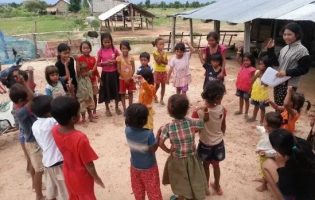


“What are the products and commodities the people in your village are buying from outside for your needs?” asked Serey who serves as a tutor of a group of youths studying to promote the well-being of their fellow villagers.
The youths listed some thirty products including sugar, soap, oil, clothes, cloth, fruits, candy, noodles, snacks and local cakes.
“Which of these products the people of the village know how to make or used to make?” asked Serey.
After some thoughts, the youths started to name one by one. “Almost all!”, the youths chorused.
Soon they realised that they are now accustomed to purchasing the highly processed products which are not good for their health at high costs instead of producing healthy organic products that their elders used to consume.
“These organic, healthy products are what the developed countries and richer population are paying high prices for to maintain good health. Here we are giving up the good and healthy for the highly processed, mass produced goods that are causing us diabetes and high blood pressure that our grandparents did not suffer from”, Serey continued.
This is a sample of the conversation of this study group. Youths in the villages are studying with a trained tutor to help them to be promoters of community well-being. This is one of the programs in Cambodia to help revitalize rural community and prevent the rural squeeze and urban drift.


The Intellectual Vacuum
The Genocide regime of Pol Pot had led to some 3 million Cambodians especially intellectuals either dead or dispersed around the world. This intellectual vacuum took a heavy toll on Cambodian education. Many returning refugees and other well-wishers established Non-governmental Organizations to contribute to educating children and youths who were deprived of education during these war years.
The quality of education especially in rural areas continues to be a challenge as government allocation and investment into education sector remain low. Primary schools are only in larger clusters of villages while secondary and high schools are mainly in small towns. There is no Kindergarten, public or private in some villages. Private and government universities are only in big towns. Courses offered are often not suitable for rural development leading to the migration of rural youths to towns. The poor quality education also leads to thousands of graduates from these universities being unemployed. This leads to rural squeeze and draining of vital human resources from rural areas.
In face of the ASEAN free trade zone in 2015 encouraging free flow of goods and services, rural Cambodia is vulnerable. In the recent years the migration of the Cambodians, both young and adults, to Thailand, Malaysia and even as far as Korea as labourers is a challenge. This leads to family break up and increase social problems. The civil society in co-operation with the Government is thus, trying to address these problems to retain the human and intellectual capital in the rural areas where 70% of the population live.
The Contributions of Civil Society Organizations
Many Non-Governmental Organizations have been working in community development, focusing mainly in the field of education since peace returned to Cambodia. Some initiated informal education through tutorial classes conducted by youths trained to assist those younger than themselves. These classes were held in houses, sheds and spaces offered by villagers. The children studied in the early mornings or evenings illumined by oil lamps or candle lights. They were responding to the thirst of the village children and youths for education, not available or accessible to them.
Gradually many in their efforts to formalize of their community education program, moved their classes from under trees, houses and public spaces to small buildings offered in partnership with villagers, well-wishers and private funders. Sometimes the lands were generously donated by parents and local authorities who understood the significance of the program.
The impact of these decades of community education program is evident. The children who participated in the classes have grown up to be youths and young adults who in turn have taken a path of service as teachers to educate those younger than themselves in their own villages bring social transformation in these villages. The community education program gradually evolved from basic literacy to supplementary academic education and then to capacity building courses to train youths.
These efforts have contributed to the total adult literacy rate (2008-2012) improving to 73.9%. The youth (15-24 years old) literacy rate for the period is 88.4% for male and 85.9% for female. The primary enrolment rate (% ratio 2008-2011) has improved to 98.2%. (http://www.unicef.org/infobycountry/cambodia_statistics.html)
Early Education for a Strong Foundation
Early childhood education is very vital to the children’s success in life. In a ground-breaking study “The Early Catastrophe: The 30 Million Word Gap by the Age of 3” by Betty Hart and Todd R. Risley of University of Kansas, found that there was a great disparity in families from various socio-economic backgrounds’ ability to shape the child’s language and vocabulary development. Their unprecedented findings showed the extraordinary disparities between the sheer number of words spoken as well as the types of messages conveyed. After four years these differences in parent-child interactions produced significant discrepancies in not only children’s knowledge, but also their skills and experiences with children from high-income families being exposed to 30 million more words than children from families on welfare. These differences in language and interaction experiences had long lasting effects on a child’s performance later in life. (http://www.aft.org//sites/default/files/periodicals/TheEarlyCatastrophe.pdf)
In Cambodia, according to Unicef statistics, the pre-primary school participation (gross enrolment ratio (%) 2008-2012) is 13 for male and 13.6 for female. Realizing the impact of lack of pre-primary school education on the drop-out rate and poor performance in school, the government undertook a major effort to collaborate with NGOs is to establish Community Schools beginning with Kindergarten or Pre-schools in villages where there are no kindergartens. It hopes that the early childhood education will provide a head start for the children.
In the past, it was the culture for a village or commune to collectively provide for a person who was able and willing to teach the children with food and village produce to support his / her living. The community had ownership of the school, built and took care of it. Later, as NGOs and government started to provide and build school and teachers became employees of government, this culture was gradually lost. The people then waited for government or NGOs to build and provide schools. Many remote villages or communes remain without schools especially pre-schools.

NGOs collaborate with government to train teacher. They, then, assist individuals to establish preschools. Teachers participate in regular teacher- training seminars that will enable them to manage the school well and learn how to evaluate on the progress of the students and when they are ready the additional grade level to their school will be added. As time passes by, the community schools expand gradually, beginning with a single class at the preschool level adding slowly additional teachers and grade levels.
Right after the beginning training seminars, the teachers discuss the vision of community schools with their communities. It has been observed that communities assume ownership of the schools in a variety of ways. The commune or village chiefs and members of the communities may offer land for the schools and encourages the community members to support the community schools. Reverting to the practices of the past, the operation of the schools is the joint ownership of the parents, teachers and village institutions. The tuition fees are paid by the parents in any form, in cash or in kind e.g. occasional supply of vegetables and meat or rice after the harvest season which is once a year.
Each school has a parent-teacher group aimed at encouraging the parents to support the school in any ways they can, specifically the payment of tuition for their children and beyond that to having conversations with parents to ensure regular attendance of their children to even building the school. In some cases, the program includes programs for mothers to learn about basic health care for their children and also to understand and re-enforce the spiritual and social education learn in schools.
Educating to Revitalize the Rural Economy
What are some of the elements in the education and training of the village youths that cause them to have such ideals and willingness to sacrifice for the good of others? Many of these youths come from families that work 10 hours a day but earning less than USD2 a day. Why these youths are willing to spend precious time to serve their community?

“We all know that education is the key to prosperity and a better life. I think the youths need to have the right skills to compete in ASEAN. English and computer skills are two very essential ones for this current time. This will lift them out of poverty and have work-life balance,”
explained Morn Sova, founder of Free Education for All (FEFA).
This organization invites youths from rural areas of Cambodia and provides English and computer literacy intensively over one or two years. Its aim is to help them set up internet business to market Cambodian products to domestic and world market.
“If internet is more accessible and cheaper, the youths can be back in the villages earning a good living. They can help their community too to access world market. Together they can have better work life balance no matter where they live,” continued Sova.
In the case of Action for Khmer Aid Services (AKAS), their aim is to provide literacy and development program that incorporates environment, health, agriculture for poor people to have a better life. The organization sees English education and life skills as essential in lifting the villagers out of poverty.
“Cambodia is a small country with its own language. No other country uses our language. To communicate with the rest of the world, we need an international language. In ASEAN, it is English. If our youths can communicate in English, they can learn through internet from the rest of the world, be it agriculture or technology,”
said Lim Kim Eang, the Director of AKAS.
AKAS collaborates with international funders and local partners to bring different development projects to the villages. Their current projects are in building roads, ponds and cannels in remote villages. They also train youths in organic farming, making environmental friendly bricks for building houses and home garden.
The effects of climate change have also affected the farmers in Cambodia. There is less rain leading to drought. Sporadic flash floods worsen the harvests. To assist the farmers, AKAS recently piloted a greenhouse to demonstrate to villagers. Once the farmers master the use of green-houses to control the environment for good harvest, they will be replicated this in their own villages and share with other villages. This they hope can contribute to the improving the environment and work life balance.
AKAS has trained the commune council members in some communities to get a better analysis and collect data of the needs for the community through Vulnerability Reduction Assessment (VRA) recommended by UNDP. This has improved the reading of reality in the communes and devised better strategies for the development of the villages. It is a small but important step towards alleviating poverty.
The approach adopted by another organization, Cambodian Organization for Research, Development and Education (CORDE) is founded on their conceptual framework of education. Education, to them, has dual purpose – personal transformation and social transformation. The curriculum whether for literacy or supplementary academic education is based on the principle of nobility of humankind, where each individual is invited to participate, take ownership and contribute to the betterment of his or her community. CORDE’s vision is “Promoting the transformation of individuals, institutions and communities in determining their own path of development and the generation, application and dissemination of knowledge based on the principle of nobility of humankind”.
Their program is to train youths to be promoters of community well-being in villages to revitalize rural economy. An important aspect is in the developing capabilities in the field of science, technology, language, mathematics, and community development. The capabilities enable the participants to contribute to the processes of community building, instead of implementing traditionally accepted division and fragmentation of knowledge into unrelated disciplines. The program provides youths and adults courses that develop the capabilities needed for them to become the protagonists for the development of their own communities. The educational program empowers the individual and communities to effect positive social change through the process of generation and application of knowledge.
The youths who participate in the program realize the importance of contributing to the collective progress of their community.
As a result these trainees remain in their villages and dedicate themselves to take social actions and facilitate development decided by the population for individual and collective advancement of the community, be it material, spiritual, social, intellectual or economic.
Bringing Prosperity to Rural Economy
It is very re-assuring to read and reflect on the ASEAN Socio-Cultural Blueprint (ASCC) statement:
“Providing equitable access to human development opportunities by promoting and investing in education and live-long learning, human resource training and capacity building, encourage innovation and entrepreneurship, promote the use of English language, ICT and applied sciences and technology in socio-economic development activities.”
It shows we in Cambodia are going the right path and direction.
An aspects that not been adequately explored is the use of Information, Communication Technology (ICT) for development. Cambodia has a mobile phone usage of 132 per 100 people in 2012, according to Unicef statistics, meaning many have more than one mobile phones while others have none. It is almost everywhere. However, the internet users are only 4.9 per 100 people. Thus, while the people can talk and message using the mobile, using the internet prove to be too expensive and challenging. However, its potential is huge for rural youths to gain access to education and knowledge and market their products. Maybe more Khmer apps need to be developed so it can be used by those who only have Khmer capability. Collaboration with those NGOs with best practices in ASEAN can accelerate the use of ICT for development of the community.
Photographs : Courtesy of CORDE.
By: Hou Sopheap