

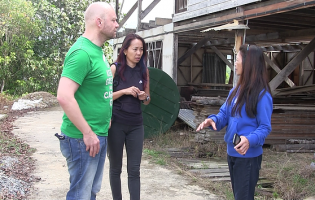

Rural flight is a common sight in East Malaysia, as many of the rural areas often lack basic necessities such as education, clean water and stable electricity. Many young people also leave to pursue careers in the city. Even more of them do not return to their hometowns, or they might only visit occasionally.
However, sometimes there are East Malaysians who return for good, and Connie Aping Trang is one of them. She was a former headmistress of a high school in urban Sarawak. After retiring, she returned to her hometown in Bario, Sarawak because she had ‘been away for too long’. At the tender age of 12, she went to Marudi, a small town about a forty-minute flight away from Bario and later on to Miri in order to further her studies. Although she missed Bario, she did not step foot on Bario ground until she retired. Now a grandmother, Connie has moved back to Bario in hope of helping to develop Bario and preserve its culture.
Being away from home for such a long time and at such a young age certainly affected Connie. In fact, not many youths who spend their developmental years in another place would return to their own homes. But Connie was different. She realized that outmigration was happening in her hometown, and she recognized the issues that it has brought to her homeland―loss of ancestral land and culture. This realization dawned on her as she observed the impact on the villages when there is a serious lack of young people to clean the community places and also perform cultural ceremonies. There is no one for the aged folk to pass on their knowledge to.
When the opportunity for her to be a community guide was presented to her, she jumped at it. She actively tried to develop ecotourism by encouraging other older women to join the training. For her, this is the best way to promote her culture, produce job opportunities and bring people to Bario while minimizing destruction towards the environment surrounding the villages.
Connie reiterated, “We need to tell them about the Kelabits and our lifestyle.”
This is very important as there is little knowledge about them in writing as well as publicity in the media. The Kelabits are a small tribe (approx. 5000) deep in the hilly forests of Sarawak. Being such a small community, the culture and traditions of the Kelabits are disappearing at an alarming rate. Connie wishes to preserve her culture, and because of this, she has become a community guide. She sees this as an extension of her life as a teacher, because she is educating people about her culture and traditions. Her deep knowledge about the Kelabit traditions and culture as well as her quick wits make her the perfect community guide.

“As a DJ, Connie plays songs of various genres, makes announcements in Kelabit and also reports the news.”
Other than being a community guide, Connie also serves as a radio DJ for the community radio station, Radio Bario. Radio Bario is the first community-run radio station in the whole of Sarawak, and it aims to provide information services for the rural communities. As a DJ, Connie plays songs of various genres, makes announcements in Kelabit and also reports the news. Connie and her team translate news in English newspapers to Kelabit beforehand then read them on air so that the older residents of Bario who didn’t go to school can receive the broadcast in a language they understand.
Bario is one of the many communities with limited mobile phone coverage, weak Internet connection at e-Bario and limited television signal. Limited connectivity is one of the reasons for the widening of the urban-rural living standard in Malaysia. With Radio Bario, the residents in the thirteen villages can keep up to date on the happenings in Malaysia and the global scene. News around the world motivate a rural community to motivate itself for development.

Image credit: www.ebario.org
“With all that she is doing, Connie is still eager to learn.”
Connie actively involves herself in all sorts of community work. She played a part in the famous Bario Food Festival in 2015 by organizing the older ladies to perform traditional Kelabit songs. These songs are on the brink of extinction as only the elderly folks still remember how to sing them. Very few of the younger people know how to sing these songs or even understand the language. Hence, having the ladies sing at such a prestigious and widely-attended event would have raised the awareness about the dying art. If the community had recorded these traditional songs, they would have collected some cultural memory for the young. Sadly, the ladies did not have the chance to perform due to time constraints. But Connie will not give up; she will continue to ensure that the songs are heard one day.
With all that she is doing, Connie is still eager to learn. Because she left Bario at such a young age, she never got to learn how to plant paddy. She hopes that she will get the chance to learn how to cultivate the world-famous Bario rice one day.
Connie certainly is a very busy woman, but to her, she is in work-life balance, because she enjoys what she is doing.
“When you work, some times you enjoy work, sometimes you don’t. You have to balance [work] with other aspects of life, where you take it easy, enjoy being with friends or find some activities that you really enjoy doing so that you are not so stressed, and you will have a meaningful life.”
“I can get both being here in Bario.”
View Connie’s full interview here.
By: Gloria Ngu