



The unique or unfortunate location of the Philippines makes the country vulnerable to disasters compared to its neighboring countries in the Asia Pacific Region. While Asia Pacific is located along the Pacific Ocean, the Philippines sits along a typhoon belt and the so-called Ring of Fire where many of the Earth’s earthquakes and volcanic eruptions occur. McGranahan et al (2007) posit that Philippine coastlines have low elevation. It receives an average of 20 tropical typhoons annually according to PAGASA (Philippine Atmospheric, Geophysical and Astronomical Services Administration and 9 of which makes landfall. Thus, the country is prone to storm surge and tsunamis. On the other hand, Rappler.com (2015), reports that the Philippines like Nepal is due for a powerful earthquake once the West Valley Fault moves. Solidum, Director of the Philippine Institute of Volcanology and Seismology forewarned the Filipino community through national TV that a 7.2 or Intensity 8 earthquake might strike any time based on historical data. He said that the West Valley Fault moves every 400 to 600 years and it has been 357 years ago since the last 90-km fault system shifted. This is quite alarming coupled with projections of 34,000 deaths and 1,144,000 injuries. According to Philstar (2014), deaths would increase to 36,000 if the earthquake occurred during the night. How these statistics have been arrived at is something that only scientists are aware of. Suffice to say that this threat is real; the question is “how do they prepare people to face this catastrophic prediction? The World Risk Index (2011) as well cautioned that many Asian and Latin American countries are prone to disaster risks due to high exposure to natural hazards and climate change but with weak coping capacities. Top on the list include: Vanuatu, Bangladesh, Timor-Leste, Cambodia, Guatemala, Costa Rica, El Salvador, Tonga, Solomon Islands, and the Philippines.
How can Filipinos survived in such a raging and ravaging climate? Honestly, we are getting ready and since we are resilient as a people, we can face any type of challenge. Culturally, people in the ASEAN are God-fearing or fatalistic, which means, everything is left to God’s will. Filipinos residing in vulnerable areas, no matter how much warnings were given would opt to die with their belongings instead of evacuating. This is because predictions seldom come true. Just like the “boy who cried wolf,” they do not want to lose again their pigs, refrigerators, or television to thieves who took advantage of the situation the first time they evacuated. This is what happened in Tacloban, when Typhoon Yolanda (International code name Haiyan) brought havoc to affected areas. Looting, according to Director Solidum can generally happen because of lack of food and amenities caused by disasters. Australians, Japanese, or Chinese, on one hand, would ensure safety to save lives and leave their belongings to chance. Hence, deeper conscientization and education processes in the Asia Pacific Region are required to make people understand that times have changed and being resilient is only one of the requirements to face a raging climate.
How would agricultural households, for instance, balance production and a raging climate? How would commuters managed to get to work? How would children get to school? They cannot afford to absent. How would people in flood-stricken areas perform their daily tasks despite being underwater?
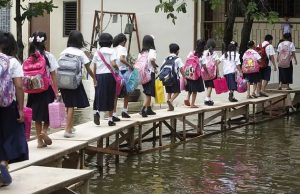
Source: International Business Times
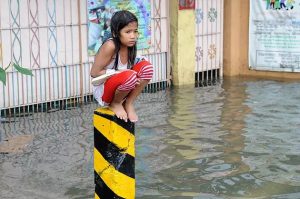
(Source: http://www.theatlantic.com/photo/2012/08/monsoon-rain-floods-manila/100349/)
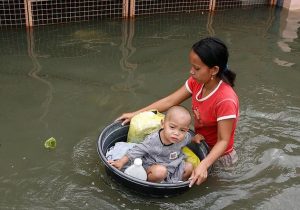
Source: http://www.boston.com/bigpicture/2009/09/typhoon_ketsana_ondoy.html
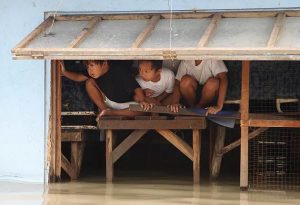
Source: http://www.boston.com/bigpicture/2009/09/typhoon_ketsana_ondoy.html
As a resilient people, Filipinos managed the odds. They find ways and means to make both ends meet but making sure everyone is safe and alive. But, is this enough? What should the community do to prepare oneself in times of a raging climate? What should people do? Leave the area? When? Where to go? What about indigenous or tacit knowledge? There are established biosignals or bio-indicators for a forthcoming disaster exhibited by animals such as the rat, fish, horse, dog, cat, snake, etc. way ahead of the event according to Dr. Rogelio Concepcion, former Director of the Bureau of Soils and Water Management and climate change expert. Local people would be familiar with these biosignals but these are not popularized.
However, communicating environmental concerns is a process that requires a more inclusive and participatory approach. It is not easy to convince people that deluge or earthquake is forthcoming until after they have been devastated. People have not been very vigilant in combating climate change. Communities continue to burn their trash in their backyards. Republic Act 9003 or the Solid Waste Management Act had been promulgated in 2001 but people continue to destroy the environment.
How are the impacts of climate change managed? How then can the Filipino family face such threats or how resilient are they towards climate change? There are several approaches that Filipinos delve into to have a balance life in times of raging climate. These mechanisms can be categorized as coping, adaptation, and mitigation.
Ideally, long-term climate change impacts are managed with adaptation strategies. Immediate impacts are managed with coping mechanisms. Adaptation strategies are products of long and iterative exposures to discreet climate change events as well as an understanding of their impacts. These strategies moderate harm and exploit beneficial opportunities (World Health Organization). Adaptation strategies are long term actions oriented towards longer term livelihood security and are associated with the following attributes:
-
Focus on finding alternatives;
-
a continuous process;
-
uses resources efficiently and sustainably;
-
involves planning; and
-
combines old and new strategies and knowledge.
Coping mechanisms are basically quick response and survival strategies of vulnerable communities after they are subjected to harsh impacts of floods and diseases brought in by super-typhoons. They are considered part of the risk and disaster programs of the National Disaster and Risk Management Office. The present state of scientific and traditional knowledge has neither the means nor scientific facilities to predict spatial and temporal impacts of climate change driven extreme weather events, mostly in the form of super typhoons. Coping strategies are stop gap survival and reactive type measures with the following attributes (Source: CARE, Angie Daze’, Kaia Ambrose and Charles Ehrhart):
-
Short term and immediate;
-
Oriented towards survival;
-
Not continuous results are sustained;
-
Motivated by crisis;
-
Often degrade resource; and
-
Prompted by lack of alternatives.
In the baseline report conducted by the Asian Institute of Developmental Studies in 2013, areas of balancing life as far as coping mechanism are concerned include health, sanitation and nutrition, stockpiling, foraging for unconventional food sources, off-farm employment, knowledge sharing, information seeking, networking, relocation, and alternative house designs and yard layout.
In terms of adaptation strategies, Filipino farmers engaged in cropping pattern adjustments (diversification, crop rotation), varietal change, tapping value chains, early warning systems, backyard food conservation, farm waste conservation, irrigation, water impounding, terracing, hedgerows, wind breaks, fire breaks, and buffer zones.
Mitigation strategies include organic farming, methane capture, residue management, cover crops, reforestation, agroforestry, nutrient management, tillage management, restoration of degraded areas, pasture management, alternate wetting and drying irrigation.
These interventions are gradually being implemented by various organizations and projects, foremost of which is the WB-funded Philippine Climate Change Adaptation Project (PhilCCAP). The Climate Change Commission as well is very active in ensuring that climate change knowledge products are well documented for easy storage and retrieval. A knowledge management system has been created and maintained as repository to address climate change.
Agricultural households, for one, had diverted into other cash crops or businesses to earn their keep. With changing climate, there is no assurance that farm yields would be good. Other balancing acts include remittances from their children abroad. Lack of local jobs outside the agriculture sector also contributed to the decision to work abroad. Sometimes, farmers are forced to sell their land or carabaos to send their children abroad on the assumption that remittances can save their future. Establishing a sari-sari store or selling street food like banana cue, barbecue (pork, innards, etc.) as alternative sources of income for daily subsistence. Some would go into fishing or labor contracting to those with bigger farms. Women would go into hired laundry, house help, nannies, or peddle manicure/pedicure services.
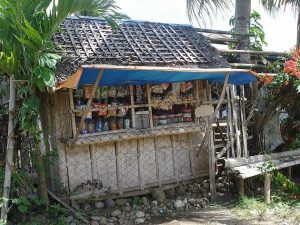 A sari-sari store in a town in Iloilo, one of the most vulnerable areas to climate change
Source: http://nitibhan.com/2010/06/
During El Niño, on the other hand, agricultural households especially women are greatly affected. Where would they get water for drinking, washing, or cooking? What food would be available for eating? They usually resort to eating bananas (cooking banana) or fruits whichever is available. The saba banana can be boiled, fried, grilled, etc. This delicious banana variety is very filling and nutritious, too. It is available anytime of the year that can withstand any weather.
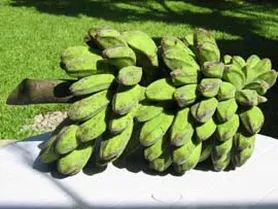
Source: http://www.marketmanila.com/archives/saba-or-cooking-bananas
In conclusion, the government has not been remised in their obligation to address climate change. In the end, Filipino’s resiliency as a culture can be the ultimate weapon towards combating climate change head on despite the onslaught that this phenomenon might bring but alternative sources or opportunities must be put in place.
Recommendations:
In order to ensure work life balance in a vulnerable area like the Philippines, the following suggestions are recommended:
-
Provide alternative livelihood for adult children of farm households which can be done offline or online through contracting.
-
The Local Government Unit in the municipality should:
-
Establish mechanisms for home-based livelihood opportunities so that workers can work from home.
-
Train women-farmers to engage in other livelihood or income-generating projects in the locality.
-
through public-private partnerships, initiate local initiatives in coming up with a program like “one town, one product” where production can be done at home.
-
Provide cheap Internet access in the office for community use so that adult children of farmers can use to transact business online.
-
-
The trade department to identify potential local products for possible income generation that can be done at home.
-
Encourage the idea of eEntrepreneurship or offline transactions by nurturing local product development for distribution.
-
For public and private organizations to consider telecommuting as an alternative delivery mode especially if nature of work can be done at home (such as editing, writing, designing websites, database development, checking theses, test papers, accounting, etc.). This strategy saves on water consumption, energy use, transportation cost, and time wasted for travelling to and from the workplace.